Why Are Stems for Mountain Bikes Important for Better Riding Stability?


Modern trail riders demand responsive steering components to maintain precise control across aggressive terrain today. Furthermore, flex-prone handlebar mounts create sluggish steering feedback, causing rider fatigue and unpredictable handling. Today, upgrading to optimized stems for mountain bikes restores steering crispness while achieving lead-free compliance across international ISO 4210 safety standards.
Our SPT2024007A gold mountain bike stem combines 7075-T6 aviation aluminum with precision CNC machining seamlessly. Therefore, passionate cyclists replace heavy cast aluminum mounts with lightweight, ultra-durable steering components. Specifically, our SPT2024007A stem features a robust 31.8mm handlebar clamp area with press-fit installation. Explore our product-category for high-performance mountain bike stems and custom CNC cockpit components.
In addition, optimized 83/7 degree angles deliver ideal rider posture over technical downhill sections continuously. Consequently, mountain bikers maintain firm steering leverage without adding unnecessary weight to front fork assemblies. Furthermore, brilliant gold anodized finishes enhance overall bicycle aesthetics while offering superior corrosion resistance.
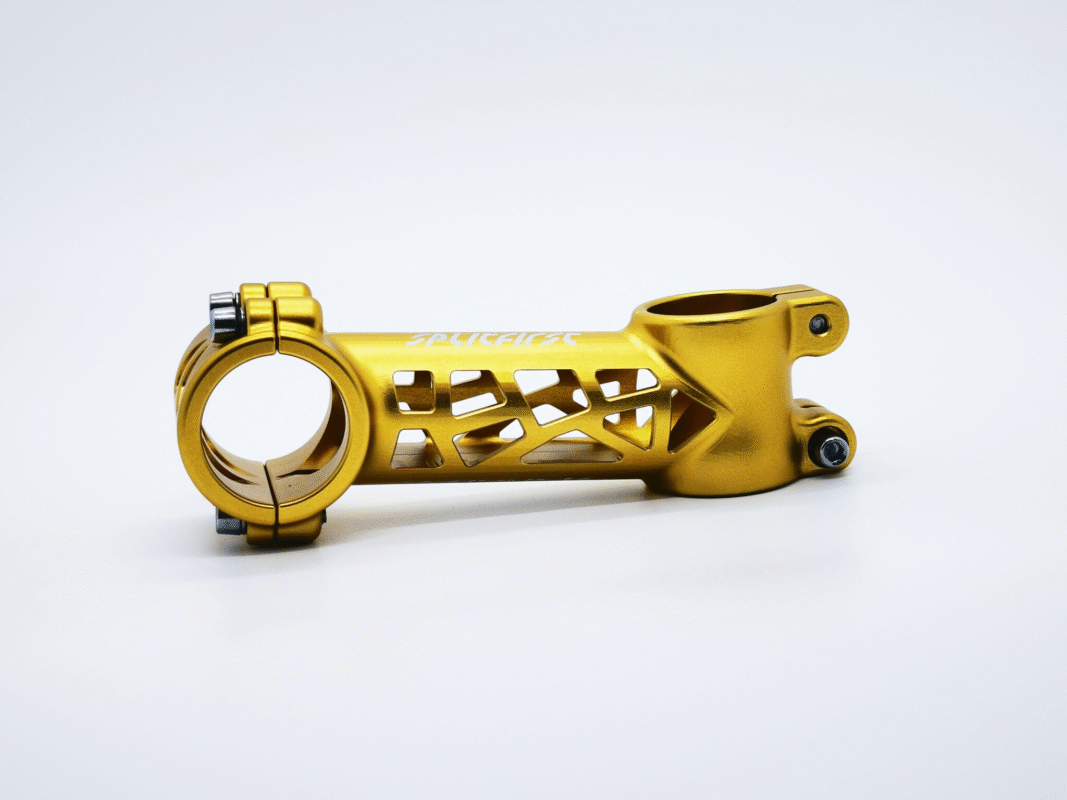
Steering Stability Bottlenecks: Resolving 4 Trail Riding Issues
Mountain bikers face front-end flex, steering twitchiness, cockpit slippage, and excessive front-end component weight. Below, we examine four primary handlebar mounting challenges and our technical stem solutions.
Cockpit Flex and Sluggish Steering Response on Rough Trails
Cast alloy stems flex under heavy handlebar loads when negotiating rocky drop-offs and high-speed cornering. Specifically, lateral material deflection delays steering inputs, making front wheel tracking feel vague and unpredictable. Therefore, aggressive trail riders require ultra-rigid CNC machined stems to maintain crisp handling feedback. Consequently, installing high-rigidity stems for mountain bikes eliminates steering lag during technical downhill descents.
Example: A trail rider experiences loose handling while descending a steep, rock-strewn singletrack trail at high speed. Flexible stem material flexes under heavy cornering pressure, causing the front tire to wander off target lines. Check our technical-guide for bike stem geometry selection and handlebar clamp torque guides.
In contrast, our SPT2024007A stem uses 100% CNC machined 7075-T6 aviation aluminum construction. Furthermore, high structural stiffness converts every handlebar movement directly into sharp, accurate front wheel directional changes. Thus, cyclists ride challenging trails confidently while maintaining precise directional control through technical turns.
Handlebar Slippage and Clamp Creep Under Heavy Impact Loads
Substandard faceplate clamps lose clamping force under heavy landing impacts, allowing handlebars to rotate unexpectedly. Specifically, handlebar rotation alters rider reach angles mid-ride, causing sudden loss of control during steep jumps. Therefore, mountain bike cockpits require engineered clamping surfaces that distribute retention force evenly. Consequently, selecting a high-precision mountain bike stem prevents handlebar slippage under heavy trail impacts.
Example: A freeride cyclist lands a high-impact jump, forcing her 31.8mm handlebars to rotate forward inside the clamp. Loose clamping forces force an immediate emergency stop to realign the cockpit and re-tighten faceplate bolts. In contrast, our SPT2024007A features a specialized press-fit clamp design.
Additionally, precision machining ensures uniform pressure across all 31.8mm handlebar contact surfaces during installation. Furthermore, strict 6 Newton meter hardware torque limits lock handlebars securely without crushing lightweight carbon fiber bars. As a result, mountain bikers jump and drop confidently without experiencing unexpected handlebar movement.
Awkward Body Posture Causing Rider Fatigue on Long Climbs
Incorrect stem angles throw off rider weight distribution, causing back strain and front wheel lifting during steep climbs. Specifically, poor cockpit height forces riders into awkward riding positions, reducing pedaling efficiency across long endurance rides. Therefore, endurance cyclists require optimized stem rise angles to achieve balanced posture and maximum pedaling leverage. Consequently, deploying an ergonomic bike stem improves climbing traction and riding comfort.
Example: An endurance mountain biker suffers lower back fatigue while climbing steep mountain trails for several hours continuously. An improper stem angle places excessive weight on his wrists while lifting his front tire off traction surfaces. In contrast, our SPT2024007A stem features an optimized 83/7 degree angle layout.
Additionally, a compact 43mm steerer stack height allows precise handlebar height tuning using standard headset spacers. Furthermore, balanced rider positioning improves front tire ground contact, preventing front wheel washout on loose climbs. Thus, riders conquer long trail climbs efficiently while minimizing physical body fatigue.
Excessive Front-End Weight Hindering Agility and Acceleration
Heavy forged stems add unnecessary mass to bicycle steering axes, making front wheel lifting over obstacles difficult. Specifically, heavy cockpit components increase steering inertia, slowing down rapid directional adjustments in tight forest singletrack. However, hollowed CNC aluminum stems reduce overall component weight while maintaining maximum structural strength.
Example: A cross-country racer struggles to lift his front wheel quickly over sudden exposed tree roots on fast trails. Excessive front-end component weight delays manual wheel lifts, causing direct rim impacts and momentum loss. In contrast, we engineer the SPT2024007A stem to weigh just 196g (+/-0.5g).
Additionally, strategic CNC pocketing removes excess material without weakening key structural stress points along the body. Consequently, light front-end weight enables fast manual wheel lifts and rapid steering corrections through tight switchbacks. Thus, competitive cyclists gain maneuverability and speed while preserving maximum cockpit component durability.
Technical Solutions: Precision Engineering for Mountain Bike Stems
Superior bicycle stems combine high-strength aviation aluminum, precision 3D CNC machining, exact torque tolerances, and durable anodized finishes. Furthermore, strict manufacturing standards guarantee reliable steering performance across demanding off-road riding conditions.
7075-T6 Aviation Aluminum and 100% CNC Machining
Engineers construct the SPT2024007A gold stem using premium 7075-T6 aviation aluminum for maximum strength-to-weight ratios. Specifically, full CNC milling carves the stem body from solid billet blocks, eliminating internal material flaws completely. Furthermore, high structural density resists bending forces during high-load sprint efforts and hard landing impacts. Consequently, mountain bikers rely on a cnc machined aviation aluminum stem for extreme trail conditions.
In addition, sleek gold anodizing shields raw aluminum surfaces against water, mud, and trail debris corrosion. Specifically, durable surface coatings prevent scratching and discoloration, maintaining vibrant aesthetic appearances over years of riding. Consequently, riders upgrade bicycle aesthetics while gaining professional-grade steering performance.
Press-Fit Clamp Design and Strict Hardware Standards
Our SPT2024007A stem incorporates an innovative press-fit clamp that installs and removes like a standard stem easily. Specifically, precision bolt threading supports exact 6 Newton meter torque limits across all hardware fasteners uniformly. Discover options in our product-category mountain bike stem catalog.
Moreover, every stem undergoes strict dimensional verification to ensure perfect fitment onto 31.8mm handlebars and 1-1/8 inch steerers. Thus, professional cyclists and passionate amateurs install components quickly without requiring custom fitting modifications. Consequently, mountain bike builders optimize cockpit stability while streamlining bicycle assembly workflows.
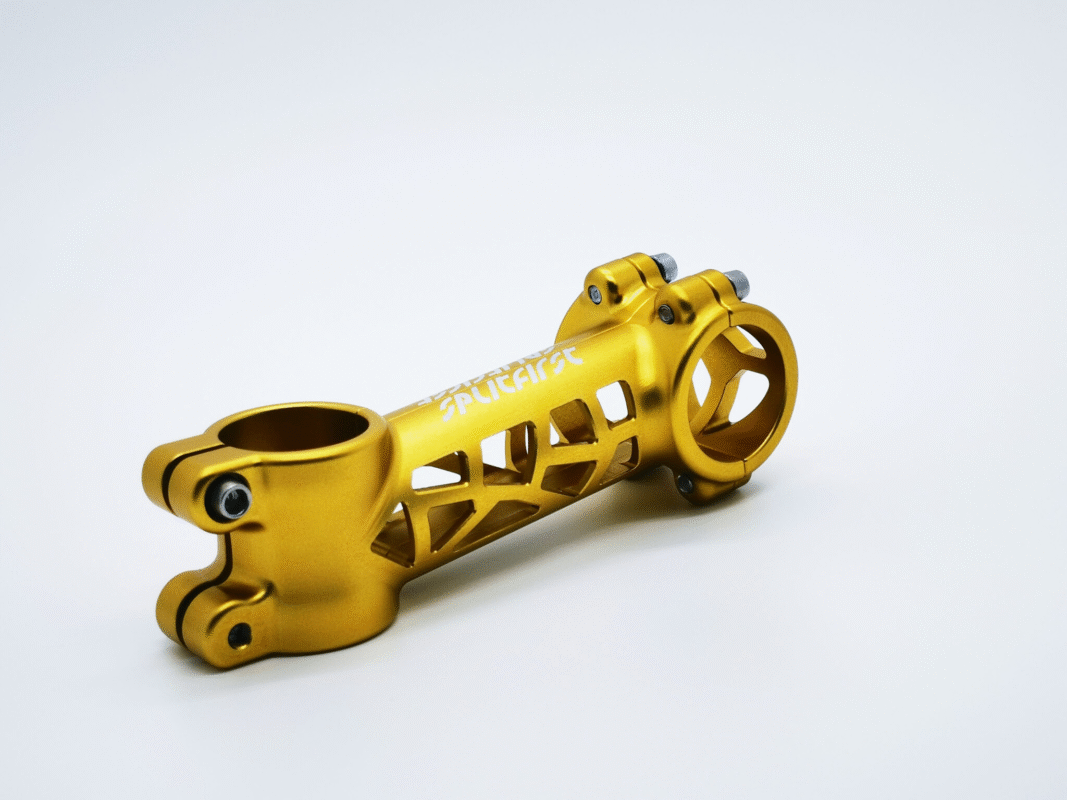
Product Parameter & Specification Overview
Review key technical specifications comparing standard cast aluminum stems against the SPT2024007A CNC Gold Stem.
| Technical Parameter / Feature | Standard Cast Aluminum Stem | SPT2024007A CNC Gold Stem | Rider Stability Advantage & Benefit |
| Material & Construction | Cast 6061 Alloy (Flex-Prone) | 7075-T6 Aviation Aluminum (100% CNC) | Delivers Superior Rigidity & Eliminates Steering Lag |
| Handlebar Clamp Diameter | Variable / Loose Tolerances | 31.8mm Precision Press-Fit Clamp | Prevents Handlebar Rotation & Clamps Securely |
| Component Weight | 250g – 300g (Heavy) | Lightweight 196g (+/-0.5g) | Improves Steering Agility & Eases Obstacle Lifts |
| Stem Angle Geometry | Fixed 0° Flat Rise | 83 / 7 Degree Optimized Angle | Balances Rider Weight Distribution & Comfort |
| Hardware Torque Specs | Uncalibrated Bolt Threads | 6 Nm Max Torque on All Hardware | Protects Carbon Bars & Maintains Uniform Clamping |
| Steerer Stack Height | 50mm Stack Height | Compact 43mm Steerer Height | Allows Precise Handlebar Spacing Adjustments |
Versatile Applications in Mountain Biking and Trail Riding
Modern mountain bike cockpits require adaptable stems that perform reliably across diverse riding disciplines. Furthermore, high-rigidity CNC stems perform smoothly across cross-country trails, technical all-mountain descents, and urban commuter setups.
For instance, trail riders deploy SPT2024007A gold stems to conquer aggressive rocky trails and steep technical descents. Specifically, high torsional stiffness keeps handlebars aligned perfectly when blasting through rough rock gardens at high speeds. Consequently, riders maintain total control without experiencing front-end chatter. Learn details in our technical-guide bicycle stem installation and torque adjustment guide.
Additionally, cross-country racers utilize these lightweight 196g stems to maximize climbing efficiency during marathon race events. Perfect 31.8mm clamp fitment transfers full pulling force to handlebars during out-of-saddle climbing sprints. Thus, endurance racers convert full body effort into forward trail momentum effortlessly. Therefore, our 31.8mm handlebar stem clamp solutions successfully merge light weight, extreme rigidity, and stunning custom gold styling.